About Chinese Language Education Council of NSW Inc
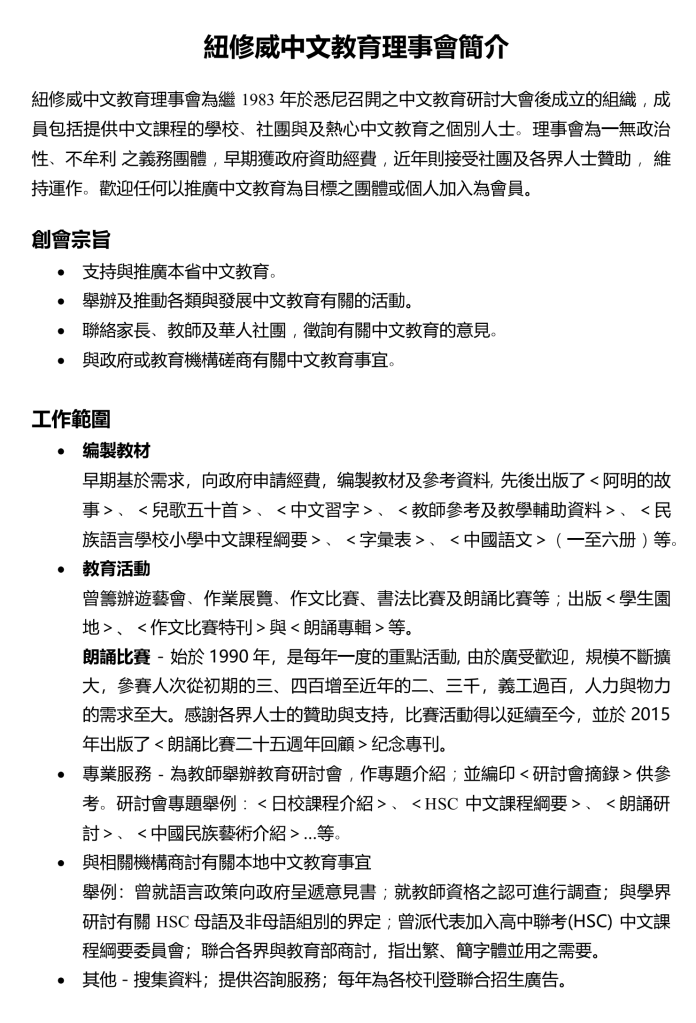
An open forum on Chinese language education was held in Sydney in 1983. Subsequently the Chinese Language Education Council of NSW Inc. was formed. Its membership comes from the Chinese community, including schools that are providing Chinese language courses, community organisations and a range of individuals who are dedicated to maintaining and extending Chinese language. The Council is a non-political and non-profit making organisation supported by volunteers. In its formative stage, it had been supported by funding from the State government, but in recent years, it has been able to continue with its work because of financial supports provided by community organisations and individuals. The Council welcomes any organisations or individuals that are dedicated to promoting Chinese language education to its membership.
OBJECTIVES OF THE COUNCIL
- To support and promote Chinese language education in New South Wales.
- To promote Chinese language through running various educational activities
- To consult with parents, teachers and organisations on matters relating to Chinese language education.
- To hold discussions with government or educational organisations on matters relating to Chinese language education.
SERVICES PROVIDED
- Compiling and Producing Teaching Materials
In its early years of operation, the Council had successfully obtained funding from the State government to produce teaching materials and reference books to meet the need of the Chinese language schools. Consequently a series of publications were produced. These books include: ‘Ah Ming’s Story’, ‘Fifty Children Songs’, ‘Learning Chinese Characters’, ‘Teachers Reference Book and Supplementary Teaching Materials’, ‘Chinese Language Course Guideline for the Primary Classes in Community Language Schools’, ‘Chinese Vocabulary List’, ‘Chinese Language Textbooks’ (Books 1 to 6) etc.
- Educational Activities
The Council had organised various activities to improve students’ language skills. They include the Language School Students Concert, exhibition of students’ work, Chinese (literary) composition competitions, Chinese calligraphy competitions etc. It had also published several booklets, including ‘A Collection of Students Writing’, ‘Selected Work from the Winners of Chinese Composition Competitions’, ‘National Chinese Eisteddfod Special Publication’, etc.
National Chinese Eisteddfod made its debut in 1990. It is our most important annual activity. The Chinese Eisteddfod has grown rapidly in size every year because of its popularity with the students. Initially there were only three to four hundred students taking part in the competitions. In recent years, the number of entrants had risen to two to three thousand and more than one hundred volunteers are helping to run this event. It requires a large number of people and plenty of material resources to make the Eisteddfod a success. Owing to the supports of all sectors of the community, we are able to keep the event running. In 2015 a special booklet titled ‘25 Years of National Chinese Eisteddfod’ was produced to commemorate the achievement of this wonderful event.
- Professional Services
The Council had held education seminars on various topics for the Chinese language teachers; excerpts from the seminars were also produced for the reference of the teachers. Some of the special topics presented were: introduction to main stream school Chinese courses, the HSC Chinese language courses guideline, poetry and prose recitations, introduction to Chinese national arts etc.
- Holding discussions with relevant organisations on matters concerning Chinese language education.
Work done in the past by the Council includes: making representations to the State government on its language policy; investigating the accreditation of teaching qualification of Chinese language teachers; discussing with the academic circles about classification of native and non-native HSC candidates; providing representative to the HSC Chinese Course Guideline Committee; as a member of a delegation which held discussion with the NSW Department of Education on the issue of using both traditional and simplified forms of Chinese characters in HSC.
- Other services– collecting information of interest to the Council, providing advisory service, advertising enrolment information of all member schools in the local Chinese newspapers annually.
 紐修威中文教育理事會